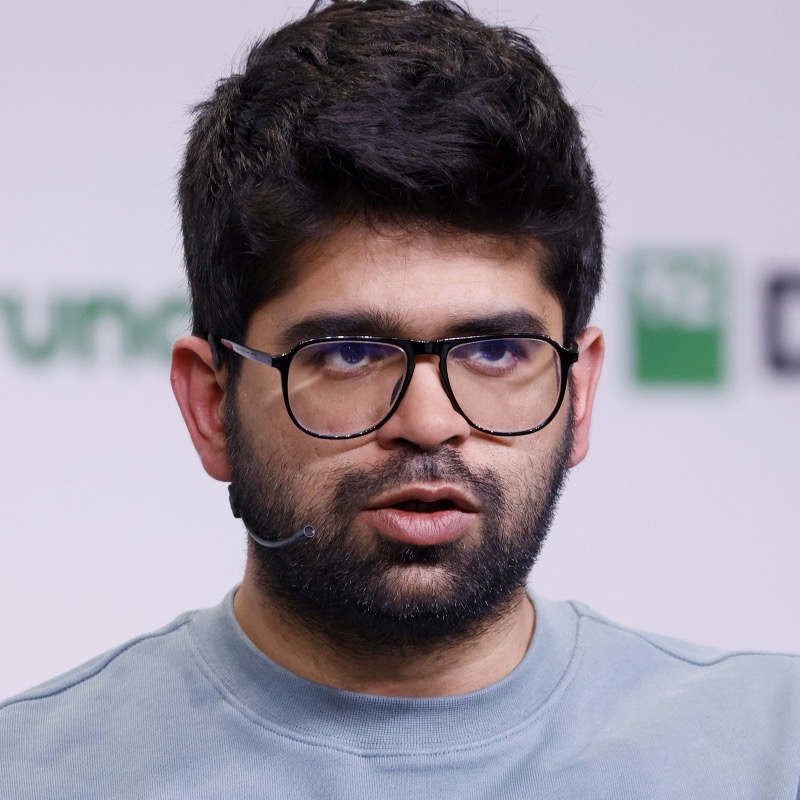
Guillermo Rauch
The Argentine Who Learned English from Software Manuals and Built the Web's Future
The lab's read
Open source is the greatest distribution
Rauch's trajectory is evidence that in developer tools, distribution is the moat and open source is how you build it. Next.js is the rare case where giving away the core technology increased the value of the company wrapped around it. As AI coding tools absorb more of the stack Vercel monetizes, this file documents the model that every incumbent in that market is now measured against.
A Kid in Argentina
Guillermo Rauch grew up in Lanús, a small town in Buenos Aires, Argentina. He didn't have the traditional path to tech, no Stanford, no Silicon Valley connections. What he had was the internet and an obsessive curiosity about how things worked.
At eleven years old, Rauch taught himself web development so he could take on remote JavaScript projects as a contractor. To do that, he first had to learn English, which he did by reading software manuals and documentation.
I learned English by reading software manuals. The web was my university. Open source was my credential. I didn't need permission to contribute, I just needed to write good code.
Open Source as a Career
Rauch spent his early teens advocating for Linux and teaching people how to use it. He developed a passion for JavaScript and web development that led him to join the MooTools core team, a major JavaScript framework of its time.
His open source work wasn't just a hobby; it was his resume. He created Socket.io (real-time communication), Mongoose (MongoDB ODM), and other tools that are still used by millions of developers today. Each project built his reputation and his network.
Socket.io
Real-time web standard
Mongoose
MongoDB for Node.js
Next.js
React framework king
The Journey to San Francisco
At 17, Rauch got his first full-time job offer, in Switzerland. Within a week, he was on a plane. When he arrived at the train station, the company's CEO couldn't believe this young kid was their new engineer. Rauch just smiled and got to work.
When the company opened a San Francisco office, Rauch saw his chance. He moved to SF and started his first company, Cloudup, which was later acquired by Automattic (the company behind WordPress). The acquisition gave him both validation and capital for his next venture.
Rauch didn't wait for credentials. He built things, shared them, and let his work speak for itself. By the time he arrived in SF, the developer community already knew his name from his open source contributions.
Building Vercel
In 2015, Rauch founded ZEIT (later renamed Vercel) with a simple insight: deploying websites was unnecessarily hard. He'd seen developers struggle with servers, configurations, and DevOps when all they wanted was to ship their code.
Vercel made deployment as simple as "git push." But the real genius was Next.js, an open source React framework that Vercel optimized for their platform. By giving away the framework for free, Rauch created massive distribution. Developers who loved Next.js naturally ended up on Vercel.
The Strategy: Create an incredible free tool (Next.js) that makes your paid product (Vercel) the obvious choice. The Result: Next.js became the most popular React framework. Vercel reached $3.25B valuation with customers like OpenAI, Washington Post, and Nike.
What to keep
Open source is distribution
Next.js brought millions of developers to Vercel. Give away something valuable, and you'll build an audience that follows you anywhere.
Don't wait for credentials
Rauch didn't finish school. His open source contributions were his resume. Build things that prove you can build things.
Simplification is a strategy
"Deploy with one command" isn't just a feature, it's a business model. Find complexity and eliminate it.
The internet is your home country
From Argentina to Switzerland to SF, Rauch went where the opportunity was. Your location matters less than your internet connection.
Stack the ecosystem
Vercel didn't just build a platform, they built the framework that runs on it. Control the stack, control the market.